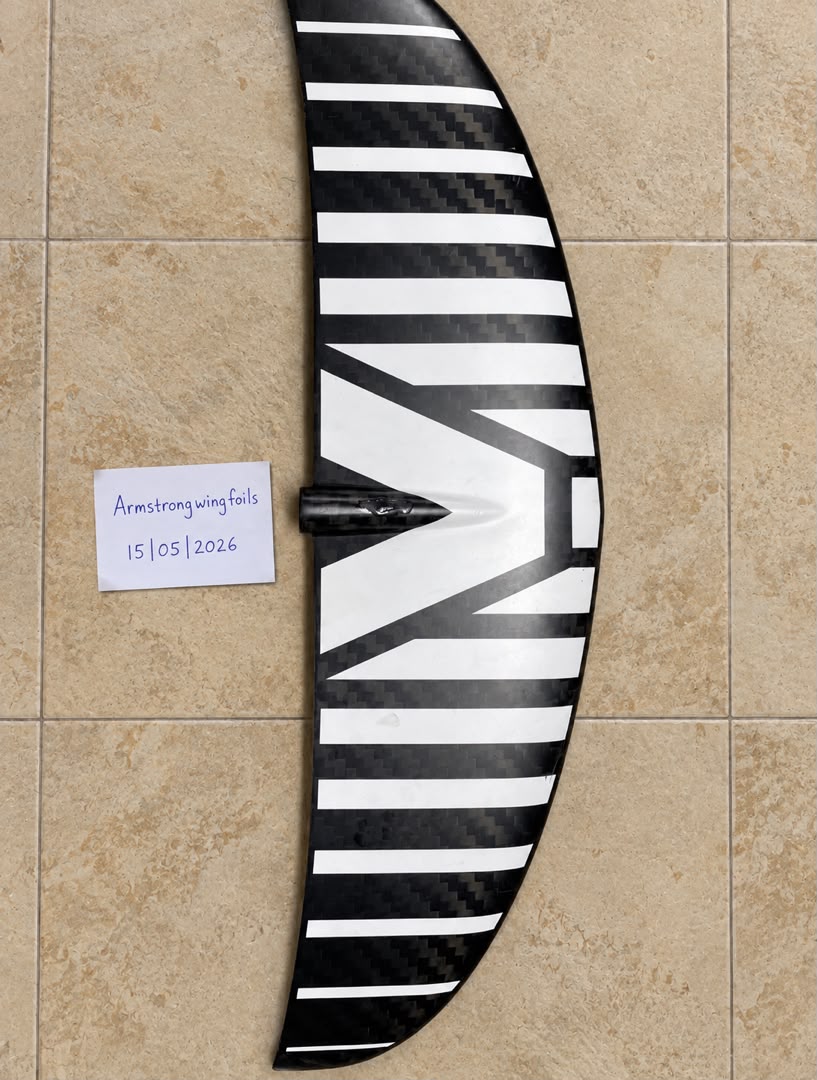


Used Armstrong HS1850

€390.00
The Used Armstrong HS1850 is a versatile high-performance front wing designed for strong low-speed lift, smooth carving, efficient pumping, and dependable stability. With its generous 1850 cm² surface area, it is especially useful for light-wind sessions, smaller waves, progression, and riders who want easier takeoff without sacrificing responsiveness.
Its carbon composite construction provides excellent stiffness and direct rider feedback, while the broad usable speed range makes it suitable for intermediate and experienced riders. The HS1850 also performs well when connecting waves, maintaining flight through weaker sections, and recovering from minor speed loss.
As a used wing, it offers excellent value when the leading edge, wingtips, mounting area, and composite structure remain in good condition. Overall, it is a strong choice for riders seeking reliable lift, smooth handling, and versatile real-world performance.
Used Armstrong HS1850 A+ Front Foil – High-Speed Glide, Low-End Lift, Pumping Efficiency, and Versatile Foiling Performance
Used Armstrong HS1850 Overview
The Used Armstrong HS1850 is a large performance front wing from Armstrong’s HS, or High Speed, generation. Importantly, HS1850 should not be confused with an HA Front Foil because the HS series was developed around a different balance of speed, stability, carving response, and accessible performance. Armstrong’s historical buyer guide positioned the HS family between the forgiving CF range and the more performance-focused HA range, making HS models particularly suitable for progressing intermediate and advanced riders.
With an 1850 cm² surface area, 940 mm wingspan, and approximately 1350 g weight, this front wing was designed to produce substantial low-speed lift without sacrificing the faster, more reactive personality expected from the HS series. Its construction uses a high-density foam core wrapped in intermediate-modulus and high-modulus carbon, creating a stiff structure capable of handling substantial riding loads.
Why Choose the Used Armstrong HS1850?
The HS1850 stands out because it combines generous surface area with surprisingly responsive handling.
A larger hydrofoil front wing can help heavier riders, light-wind riders, and those riding smaller waves achieve flight at lower speeds. However, the HS1850 was also shaped to provide more speed and glide than Armstrong’s earlier beginner-oriented designs.
Consequently, it remains an attractive used option for riders wanting dependable hydrofoil lift stability alongside greater performance.
HS1850 Technical Specifications
Confirmed specifications include:
- Front-wing area: 1850 cm²
- Wingspan: 940 mm
- Approximate weight: 1350 g
- High-density foam core
- Intermediate-modulus and high-modulus carbon construction
- A+ connection version available
- Designed for stability and predictable response across a broad speed range
High Speed Design Versus HA Front Foil
Although someone searching HA Front Foil or HA Front Foil for sale may encounter the HS1850, the two ranges should not be treated as identical.
Armstrong categorized HS as High Speed, while HA represented its higher-aspect performance family. The HS range was designed to provide more speed, glide, and reactivity than CF while remaining more accessible than the HA generation.
Therefore, the HS1850 can be a useful progression wing rather than an extreme high-aspect design.
Low-Speed Lift and Stability
The large 1850 cm² area helps produce substantial lift at relatively low speeds.
This makes the HS1850 useful when wind becomes lighter or wave energy becomes weaker.
At the same time, its refined profile helps the front foil remain predictable as speed increases.
For riders prioritizing hydrofoil lift stability, this broad operating range is one of its strongest qualities.
Wing Foiling Performance
The HS1850 became particularly popular as a wing foil front wing because its generous area can provide early takeoff and strong low-end support.
Historical Armstrong guidance included the HS1850 among options for heavier riders in wing use, while retailer descriptions note that experienced riders could use it across an unusually broad wind range.
Combined with an armstrong wing or other armstrong wings, it can create a forgiving yet energetic freeride setup.
Surf Foiling Capability
For surf foil use, the HS1850 is especially relevant to heavier riders and smaller waves.
Armstrong’s historical recommendation chart included the HS1850 for riders above approximately 90 kg in smaller surf.
When paired with a compact surf foil board, surf foilboard, or other surf foil boards, it can generate the lift needed to remain connected through softer sections.
Pumping and Glide
The HS1850 was designed to offer better glide than Armstrong’s more entry-oriented wings.
After leaving a wave, the rider can use controlled pumping to maintain speed and connect another section.
That makes it useful for riders interested in progressing from simple rides toward longer, more efficient armstrong foiling sessions.
Downwind Riding
Historical guidance also positioned the HS1850 for downwind use, particularly for heavier riders.
It can therefore complement an armstrong downwind board, armstrong downwind boards, or an armstrong downwind foil board when early lift and supportive low-speed performance matter.
Riders familiar with the armstrong v1 downwind board may appreciate the HS1850 as an earlier-generation solution for accessible downwind progression.
Armstrong Midlength Pairing
An armstrong midlength or armstrong mid length board can also pair well with a large efficient front wing.
The board’s longer waterline can help build speed before takeoff, while the HS1850 provides the required lift underneath.
This combination can be particularly useful during lighter-wind sessions.
SUP Foiling
The HS1850 is also relevant for anyone selecting a foil for sup.
Armstrong historically recommended it for heavier riders in smaller SUP-foil waves and for downwind use.
Its size provides the support needed for slower paddle-generated takeoffs.
Kite Armstrong Applications
For riders researching kite armstrong equipment, the HS family was also used extensively across kite applications.
However, Armstrong’s historical chart generally recommended smaller HS sizes for kite riding because the higher speeds generated by a kite reduce the need for a very large front wing.
Therefore, the HS1850 is better known for wing, SUP, surf, pumping, and downwind-oriented riding.
Armstrong A+ System
The A+ version connects into Armstrong’s modular system through the armstrong fuselage.
The A+ architecture was developed to improve stiffness and durability when handling the higher torsional forces generated by larger and more efficient wings. Titanium barrel nuts form part of this connection design.
This lets riders integrate the HS1850 into compatible armstrong foils systems.
Armstrong Performance Mast
Pairing the wing with an armstrong performance mast can further improve stiffness and rider feedback.
A rigid mast helps transfer carving and pumping input directly to the foil.
Customers researching armstrong integrated foil masts price or armstrong integrated foil masts price 2025 should remember that mast pricing is separate from the front wing and varies according to generation, material, and mast length.
Board Compatibility
A suitable armstrong foil board or other armstrong foil boards should be chosen according to rider weight, water-start method, conditions, and discipline.
Different foiling board and foiling boards designs change how quickly sufficient speed is generated before the HS1850 begins producing usable lift.
Armstrong Downwind Foil Progression
While more modern armstrong downwind foil designs now offer significantly higher aspect ratios and improved glide efficiency, the HS1850 remains valuable for riders who prioritize accessible lift and controlled behavior over maximum span and ultra-low drag.
Its large area can therefore make learning longer connections easier.
Why Buy a Used HS1850?
People searching armstrong foils for sale can find excellent value in a properly maintained HS1850.
Before purchase, inspect the leading edge, trailing edge, wingtips, mounting interface, carbon surfaces, and screw points.
Cosmetic marks are common on used equipment, but structural cracks, delamination, or damaged mounting areas deserve closer inspection.
Why the Used Armstrong HS1850 Remains Relevant
The Used Armstrong HS1850 combines 1850 cm² of lifting area, a 940 mm span, carbon composite construction, strong low-end lift, smooth carving, pumping capability, and predictable higher-speed behavior.
For riders comparing older armstrong foils for sale with modern equipment, it remains a compelling performance option. Whether paired with an armstrong wing foil system, supportive board, downwind-oriented setup, or surf-focused configuration, the HS1850 provides the combination of lift, stability, speed, and progression potential that made Armstrong’s HS generation so widely respected.
Takeoff Efficiency, Low-Speed Lift, Pumping Response, Carving Control, Speed Range, and Real-World Performance
The Used Armstrong HS1850 is built around a broad and highly usable performance range. Its relatively large surface area gives it strong low-speed support, yet its shape was developed to remain faster and more responsive than many beginner-oriented large wings. This combination makes it especially useful for riders who want easier takeoff, dependable control, and enough speed to progress beyond basic cruising. In real-world use, the wing rewards smooth technique, balanced setup, and efficient movement rather than aggressive correction.
Early Takeoff Performance
One of the strongest characteristics of the HS1850 is how readily it begins producing usable lift.
Because of its generous size, the rider does not need extremely high speed before the system starts to feel supported.
This can make takeoff more manageable in lighter wind, softer waves, or slower paddle starts.
Instead of forcing the wing upward, the rider can build forward speed and allow lift to develop progressively.
Smooth Lift Development
A good large wing should not feel as though it jumps suddenly out of the water.
The HS1850 is more useful when the rider accelerates gradually and allows lift to build in a controlled way.
This produces a smoother transition from water contact to full flight.
A progressive takeoff also makes pitch easier to manage.
Low-Speed Support
The HS1850 remains supportive at speeds where smaller wings may begin to lose efficiency.
This is particularly helpful during slow carving, weak-wave sections, and low-power conditions.
The rider can stay airborne longer without constantly forcing the system forward.
That extra support can also make progression less tiring.
Stability During Acceleration
As speed increases, the wing continues to feel relatively predictable.
The rider can accelerate without needing to make major balance corrections.
This is important because some large wings become overly sensitive as they gain speed.
The HS1850 is designed to offer a more manageable transition.
Broad Speed Range
Although the wing is large, it is not limited to slow cruising.
Its profile allows it to carry more speed than many entry-level designs of similar size.
This gives the rider room to progress into faster riding without immediately needing a smaller wing.
That broader range can make it a very practical long-term option.
Light-Wind Riding
In lighter conditions, the HS1850 can be especially effective.
When power is limited, the wing’s size helps generate lift at lower speed.
This allows the rider to make better use of small gusts or weaker water energy.
The result can be more successful takeoffs and fewer wasted attempts.
Moderate-Wind Conditions
In moderate wind, the wing becomes easier to accelerate.
The rider can reach flying speed quickly and then focus on carving, transitions, and pumping.
Because lift is plentiful, the rider does not need to rely on excessive power.
This can make sessions feel more relaxed.
Stronger-Wind Conditions
In stronger wind, the wing will feel more powerful.
The rider should use smaller inputs and avoid overloading the front foot.
At higher speed, smooth control becomes more important.
An experienced rider can still use the wing effectively, but setup balance matters more.
Paddle Takeoffs
For paddle starts, the large area can be very useful.
The rider can generate enough forward speed with fewer strokes than may be required for a smaller wing.
Once speed is established, lift develops relatively early.
This can reduce fatigue during repeated attempts.
Wave Entry
When entering a wave, the rider does not need to wait for the steepest part of the face.
The wing can begin working in softer energy.
This creates more time to establish balance before the ride becomes fast.
Earlier engagement can also improve positioning.
Small-Wave Performance
Small waves are one of the situations where the HS1850 can be particularly enjoyable.
Its low-speed support allows the rider to stay flying through weaker sections.
When the wave loses power, the rider can use pumping to maintain momentum.
This extends ride length.
Larger-Wave Performance
On larger waves, the rider must manage speed more carefully.
The wing can accelerate quickly.
Smooth carving and controlled pitch become more important.
The rider should avoid making abrupt movements when the system is already moving fast.
Pumping Efficiency
The HS1850 offers useful pumping capability because its size helps maintain lift between cycles.
The rider can use controlled up-and-down movement to preserve speed.
A smooth rhythm is usually more effective than aggressive pumping.
The wing rewards technique more than brute force.
Pumping Through Flat Sections
When crossing flat water between usable sections, the rider should focus on keeping movements consistent.
The wing provides enough support to make those connections achievable.
However, unnecessary steering can reduce efficiency.
A straighter line usually preserves more speed.
Glide Between Pumps
The HS1850 also carries momentum reasonably well for its size.
After each pump, the wing can continue moving forward before the next cycle begins.
This helps reduce the number of movements required.
Less wasted energy means longer sessions and reduced fatigue.
Carving Response
Despite its large area, the HS1850 can turn smoothly.
The rider should initiate the carve progressively.
Once banked, the wing follows a predictable arc.
This makes it suitable for both broad turns and more technical directional changes.
Slow-Speed Carving
At lower speed, the wing remains supportive enough to let the rider turn without immediately dropping out of flight.
This is useful in small surf and weaker conditions.
The rider can complete turns more calmly.
Higher-Speed Carving
At higher speed, the wing becomes more responsive.
The rider should reduce the amount of input.
A small lean can produce a strong change in direction.
This makes smooth technique important.
Front-Foot Pressure
The amount of front-foot pressure depends heavily on mast position and stabilizer setup.
If the rider feels excessive pressure, the setup may need adjustment.
Small changes can make the system much more comfortable.
Rear-Foot Pressure
Too much rear-foot pressure can make the wing rise too aggressively.
This can create repeated pitch corrections.
A balanced setup should allow the rider to maintain level flight without constantly fighting the wing.
Mast Position
Mast placement strongly affects how the wing feels.
Moving the mast forward can increase front-foot pressure and earlier lift.
Moving it backward can calm the setup.
Adjustments should be made in small steps.
Stabilizer Influence
The rear stabilizer also changes the overall feel.
A larger stabilizer can create more pitch support.
A smaller one may make the system feel freer and faster.
The ideal choice depends on rider weight, skill, and conditions.
Rider Weight
Heavier riders can benefit from the wing’s strong support.
Lighter riders may find it extremely powerful.
Weight should always be considered when choosing the complete setup.
Skill-Level Progression
The HS1850 can be useful for riders progressing beyond beginner equipment.
It offers enough stability to remain approachable while providing more speed and responsiveness.
This makes it a practical bridge toward more advanced riding.
Intermediate Rider Use
Intermediate riders can use the wing to improve pumping, carving, and faster flight.
The predictable low-speed behavior gives them room to make mistakes.
At the same time, the increased performance encourages better technique.
Advanced Rider Use
Advanced riders may appreciate the wing in lighter conditions, weaker surf, or sessions where maximum low-end support is useful.
Its large size can still be used dynamically when the rider understands pitch and speed management.
Touchdown Recovery
If the board contacts the water briefly, the wing can often help the system return to flight.
The rider should stay balanced and preserve forward speed.
Because lift is available at relatively low speed, recovery can be easier than with a smaller wing.
Speed-Loss Recovery
When speed drops, the rider should avoid panicking and making aggressive movements.
A few smooth pumps can often restore momentum.
The wing’s size gives the rider some extra time before full stall occurs.
Choppy Water
In chop, the wing can provide useful stability.
However, disturbed water can make pitch feel less consistent.
The rider should remain relaxed and avoid overcorrecting.
Smooth-Water Conditions
Flat water makes the wing feel especially predictable.
It is easier to evaluate mast position, stance, and pumping rhythm.
These conditions are excellent for setup tuning.
Energy Conservation
One of the biggest benefits of the HS1850 is that it can reduce how hard the rider has to work.
Early lift, low-speed support, and effective pumping all help conserve energy.
This makes longer sessions more realistic.
Used Wing Inspection
A used example should be checked carefully before purchase.
Inspect the leading edge, trailing edge, wingtips, mounting area, and carbon surfaces.
Minor scratches are usually cosmetic.
Structural cracks, delamination, or loose mounting points are more important.
Leading Edge Condition
The leading edge should remain smooth and consistent.
Deep chips can disturb water flow.
Small marks are common on used equipment.
Wingtip Condition
Both tips should be inspected for cracks or impact damage.
The tips can take substantial force if the wing strikes a hard object.
Structural integrity matters more than appearance.
Mounting Interface
The connection area should remain clean, firm, and undamaged.
A precise fit is important for stiffness and control.
Any looseness should be investigated.
Overall Real-World Performance
The Used Armstrong HS1850 offers a strong combination of early takeoff, low-speed support, smooth carving, efficient pumping, and a broad usable speed range.
Its larger surface area gives the rider confidence in lighter conditions.
Its faster profile allows progression beyond basic cruising.
Its predictable lift helps make transitions smoother.
When paired with a balanced setup and ridden with controlled technique, the HS1850 remains a capable choice for riders who want dependable lift, useful speed, long sessions, and versatile real-world performance.
Construction Quality, Surface Condition, Edge Integrity, Mounting Security, Maintenance, and Long-Term Reliability
The Used Armstrong HS1850 is a high-performance composite component, so its long-term value depends greatly on structural condition, surface quality, mounting integrity, and correct maintenance. Because a large lifting surface experiences continuous hydrodynamic loading, even relatively small amounts of damage can influence feel, efficiency, stiffness, and durability. A well-maintained used example can continue performing strongly for a long time, but buyers should inspect it carefully and owners should protect it from impact, corrosion, abrasion, and unnecessary heat exposure.
Understanding Composite Construction
Composite construction allows the wing to remain relatively light while maintaining the stiffness required for controlled riding.
That stiffness is important because rider input must transfer cleanly through the complete setup.
If the structure begins to soften or delaminate, the response can become less precise.
For that reason, structural integrity matters more than cosmetic appearance.
Inspecting the Upper Surface
The upper surface should be checked under good lighting.
Look for deep scratches, cracks, dents, bubbles, or areas that appear uneven.
Small marks are common on used equipment.
However, any visible deformation should be examined more carefully.
Inspecting the Lower Surface
The underside should also remain smooth and firm.
Because water flows directly across this surface, large imperfections can affect efficiency.
Deep gouges, impact marks, or poorly finished repairs deserve attention.
The surface should not feel soft when light pressure is applied.
Leading Edge Condition
The leading edge is one of the most important inspection points.
It meets the water first and strongly influences flow quality.
Small superficial scratches may have little practical effect.
Deep chips, however, can disturb smooth water flow and increase resistance.
Why Leading Edge Shape Matters
The profile was designed to control how water moves across the wing.
If the leading edge becomes heavily reshaped through damage or poor repair, the original performance characteristics can change.
An uneven edge may create turbulence earlier than intended.
That can reduce efficiency and change handling.
Trailing Edge Condition
The trailing edge should remain straight and consistent.
Because it is thinner, it can be more vulnerable to impact and transport damage.
Small marks may be harmless.
Cracks, missing material, or obvious deformation should be treated more seriously.
Checking the Wingtips
The tips are commonly damaged during transport, storage, or accidental contact with hard objects.
Inspect both sides carefully.
Light scratches are normal.
Cracks, exposed internal material, or crushed sections are more important.
Tip Symmetry
Both tips should remain symmetrical.
If one side has been repaired or altered heavily, the wing may respond differently from one direction to the other.
This can affect turning feel.
A symmetrical profile supports more predictable handling.
Inspecting for Delamination
Delamination occurs when layers inside the composite structure begin separating.
Possible warning signs include bubbling, soft spots, hollow-sounding areas, or unusual flex.
These issues deserve careful inspection.
The wing should feel rigid and consistent across its surface.
Checking for Soft Areas
Press gently around suspicious sections.
The structure should not compress easily.
A noticeably soft area may indicate internal damage.
That type of problem is more important than ordinary surface scratching.
Mounting Interface Condition
The mounting area carries substantial load.
It should remain flat, firm, and free from cracking.
Any distortion in this region can affect alignment.
A precise connection is essential for good control.
Inspecting Bolt Holes
Bolt holes should remain clean and correctly shaped.
Look for elongation, cracking, crushed material, or unusual wear.
These areas experience repeated tightening and riding loads.
Damage here can reduce connection security.
Hardware Fit
Fasteners should pass through the mounting area smoothly.
They should not require excessive force.
Threads should be clean.
Damaged hardware should be replaced rather than forced into place.
Avoiding Overtightening
Bolts should be tightened evenly and securely.
Excessive force does not automatically improve reliability.
Overtightening can damage threads or place unnecessary stress on the mounting area.
Balanced tightening is better.
Checking for Movement
After assembly, there should be no unwanted movement.
If the wing shifts or rocks, the hardware and connection surfaces should be inspected.
Loose movement can affect control and accelerate wear.
Cleaning After Saltwater Use
Fresh-water rinsing is strongly recommended after saltwater sessions.
Salt can collect around bolts and mating surfaces.
Over time, buildup can make disassembly more difficult.
Regular rinsing keeps inspection and maintenance easier.
Drying Before Storage
The wing should be allowed to dry before being packed away.
Trapped moisture around hardware can contribute to corrosion.
Dry storage also helps prevent unpleasant buildup inside covers or bags.
Cleaning the Surface
Routine cleaning should remain simple.
Fresh water and a soft cloth are usually sufficient.
Harsh solvents should be avoided unless they are known to be safe for the finish.
The goal is to remove contamination without damaging the surface.
Avoiding Abrasive Cleaning
Rough pads and aggressive sanding should not be used casually.
They can alter the profile.
Even small shape changes can affect water flow.
Surface work should be performed carefully.
Protecting the Leading Edge
The leading edge should be kept away from concrete, gravel, metal tools, and other hard objects.
Placing the wing directly on rough ground can create chips quickly.
A padded cover provides useful protection.
Protecting the Trailing Edge
The trailing edge is thinner and may be easier to damage.
Avoid resting heavy equipment against it.
During transport, make sure nothing presses directly onto this area.
Transport Protection
Many high-performance components are damaged while being transported rather than while being ridden.
A padded bag or dedicated cover is a practical investment.
The wing should not move freely inside a vehicle.
Vehicle Storage
Do not leave the wing loose in a trunk or cargo area where heavier equipment can slide into it.
Secure it so that the edges and tips are protected.
Even a relatively small impact can leave permanent damage.
Heat Exposure
Extended exposure to extreme heat should be avoided.
Composite structures are engineered to tolerate normal conditions, but unnecessary heat can stress materials.
A closed vehicle in direct sunlight can become extremely hot.
Long-Term Storage
For extended storage, the wing should remain clean, dry, and protected from pressure.
It should not be stored underneath heavy objects.
A padded, stable position is preferable.
Avoiding UV Exposure
Long periods of direct sunlight should also be minimized during storage.
Repeated UV exposure can gradually affect surface finishes.
Shade is preferable when the equipment is not being used.
Pre-Session Inspection
Before each session, inspect the wing briefly.
Look at the leading edge.
Check both tips.
Confirm the mounting area is secure.
Make sure there are no new cracks or loose components.
Post-Session Inspection
After riding, check for fresh damage.
If the wing struck the bottom, a rock, or floating debris, inspect the affected area closely.
New damage is easier to identify immediately.
Impact Assessment
A hard impact does not always leave dramatic visible damage.
Check for changes in stiffness.
Look for fine cracks around the point of contact.
Inspect the surrounding surface carefully.
Recognizing Cosmetic Damage
Light scratching, small paint marks, and superficial scuffs are common.
These often affect appearance more than performance.
They should not automatically be treated as structural defects.
Recognizing Structural Damage
Cracks, delamination, soft areas, exposed composite material, and damaged mounting points are more serious.
These can affect strength and hydrodynamic performance.
A compromised component should be assessed properly before continued use.
Evaluating Previous Repairs
A repaired wing can still perform well.
The important factors are repair quality and restored shape.
The repaired area should feel firm.
The contour should blend smoothly into the original profile.
Signs of a Poor Repair
Uneven filler, rough sanding, visible cracking, or soft material may indicate weak repair work.
Poor contour restoration can also increase drag.
The repair should not create a noticeable bump or depression.
Maintaining the Original Profile
Shape matters.
Removing too much material can alter performance.
Adding excessive filler can do the same.
Any repair should preserve the original contour as closely as possible.
Monitoring Vibration
Unexpected vibration may indicate edge damage, loose hardware, or surface irregularity.
If the wing suddenly begins vibrating, inspect it before assuming the problem is unrelated.
Monitoring Noise
Whistling or unusual sound can sometimes appear after damage or surface alteration.
While noise does not always indicate structural failure, it can be a sign that water flow has changed.
Monitoring Handling Changes
A sudden change in turning response or pitch behavior should not be ignored.
If the setup feels different without any deliberate tuning change, inspect the wing and its connection.
Checking Weight Changes
The component should not suddenly feel heavier.
Unexpected weight can indicate moisture intrusion after damage.
If this is suspected, the damaged area should be checked carefully.
Used Purchase Inspection
A buyer should inspect the entire wing before purchase.
Check both surfaces, edges, tips, mounting area, bolt holes, and any repaired sections.
Good lighting makes small cracks easier to see.
Asking About Impact History
It can be useful to ask whether the wing has struck rocks, reef, sandbars, or other hard objects.
Honest history can help explain existing marks.
It also helps the buyer assess risk.
Cosmetic Condition Versus Performance Condition
A heavily scratched wing can sometimes remain structurally excellent.
Conversely, a visually clean wing can still have hidden damage.
For that reason, structural inspection is more important than appearance alone.
Preserving Resale Value
Careful maintenance helps preserve future value.
Rinse the wing.
Dry it.
Protect it during transport.
Store it correctly.
Address damage early.
These simple habits make a major difference.
Long-Term Ownership
A structurally healthy example can provide many more seasons of use.
The design itself does not require complicated maintenance.
Most reliability comes from careful handling and regular inspection.
Overall Durability
The Used Armstrong HS1850 can remain a dependable high-performance component when its structure is protected properly.
A smooth leading edge supports clean water flow.
Strong tips preserve symmetry.
A secure mounting area maintains stiffness.
A healthy composite structure provides predictable response.
With regular cleaning, careful transport, dry storage, correct assembly, and timely repair of any damage, a good used example can continue delivering efficient, controlled, and reliable performance over the long term.
Be the first to review “Used Armstrong HS1850”
Related products


Used Product
Used Product
Used Product
Used Product
Used Product
Used Product
Used Product
Used Product
Reviews
There are no reviews yet.