
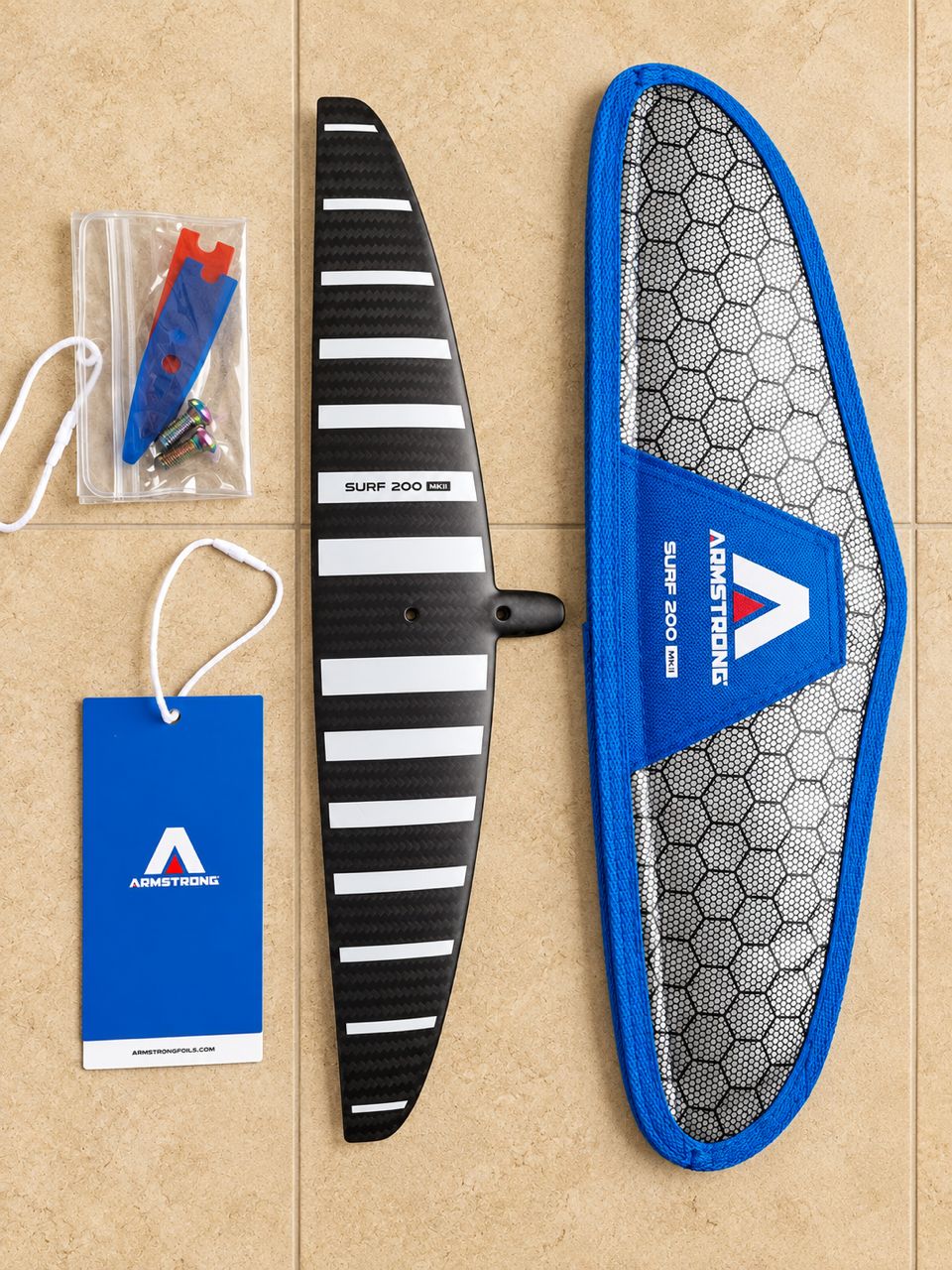


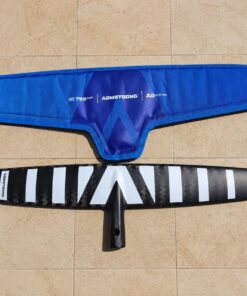
Used Surf Mk II Stabilizer


€150.00
The Used Armstrong Surf Mk II Stabilizer is a lightweight carbon rear foil designed to deliver smooth pitch control, responsive carving, efficient glide, and stable handling across surf, wing, pump, and downwind foiling. Its refined shape supports predictable control through a wide speed range while maintaining a lively, connected feel. As a used component, the leading edge, trailing edge, wingtips, mounting holes, carbon laminate, and any previous repairs should be inspected carefully before use.
Used Armstrong Surf Mk II Stabilizer — Carbon Rear Foil for Carving, Pitch Control, Speed Range, and Responsive Foiling
Used Armstrong Surf Mk II Stabilizer Design, Carbon Construction, Stability, Carving, and Foil Control
The Used Armstrong Surf Mk II Stabilizer is a performance-oriented rear foil developed alongside Armstrong’s MA Mk II front foil. Armstrong designed it to increase flow, control, carving response, and usable speed range across several foiling disciplines. The current Surf Mk II is offered in 130cm², 170cm², and 200cm² sizes, allowing riders to tune their setup according to front foil, body weight, riding style, and desired level of stability.
Its construction uses premium pre-preg Toray high- and intermediate-modulus carbon fiber, producing a lightweight yet stiff stabilizer capable of handling substantial torsional and bending loads. The design uses a mid-aspect outline, a refined foil section inspired by the MA Mk II, and efficient wingtips intended to recover well when tips briefly ventilate or leave the water. It is compatible with Armstrong’s A+ System and Alloy System.
For a used stabilizer, condition is particularly important. The leading edge, trailing edge, wingtips, mounting surface, screw holes, carbon laminate, and previous repair areas should all be inspected for cracking, chips, deep scratches, delamination, or impact damage.
HA Front Foil
An HA Front Foil emphasizes glide, pumping efficiency, and speed. Armstrong currently positions its HA range as combining strong glide with responsive riding characteristics.
Armstrong Foils
Armstrong Foils manufactures front foils, stabilizers, masts, fuselages, boards, and wings for surf, wing, downwind, pump, and assisted foiling.
Armstrong Integrated Foil Masts Price
The current Armstrong integrated foil masts price is approximately $1,999.99 USD for both the Foil Drive Foil Assist Integrated Carbon Mast and E-Foil Integrated Carbon Mast.
Armstrong Foil Board
An Armstrong foil board connects the rider to the mast and foil system. Stabilizer behavior can feel different depending on board size, mast position, foil selection, and riding stance.
Surf Foil Board
A surf foil board is generally compact and designed for low swing weight and responsive turns. A smaller stabilizer can complement this style by increasing maneuverability
Used Surf Mk II Stabilizer
.
Armstrong Downwind Board
An Armstrong downwind board emphasizes efficient waterline glide and early acceleration before takeoff.
Armstrong Midlength
The Armstrong Midlength concept bridges compact foil boards and longer downwind shapes, combining glide with manageable length.
Armstrong Downwind Foil
An Armstrong downwind foil setup generally prioritizes glide, efficiency, and the ability to connect energy over longer distances.
Armstrong Mid Length Board
An Armstrong mid length board can benefit from a stabilizer that preserves pitch control while keeping turning resistance moderate.
Armstrong Downwind Boards
Armstrong downwind boards use longer, narrower shapes designed to accelerate efficiently before lifting onto foil.
Wing Foil Front Wing
A wing foil front wing should be matched carefully with the stabilizer. Front wing size, span, and aspect ratio influence how much rear stabilizer area feels appropriate.
HA Front Foil for Sale
An HA Front Foil for sale currently starts from approximately $799.99 USD through Armstrong’s official range.
Kite Armstrong
The phrase kite Armstrong generally relates to Armstrong equipment used for kite-powered foiling and other high-speed foil disciplines.
Armstrong Foil Boards
Armstrong foil boards cover surf, wing, downwind, and midlength applications, each affecting how a foil setup feels underfoot.
Surf Foil
Surf foil riding depends heavily on turning response, pitch stability, pumping efficiency, and the ability to reconnect with wave energy.
Armstrong Foiling
Armstrong foiling equipment is designed as a modular system where board, mast, fuselage, front foil, and stabilizer all influence the final ride characteristics.
Foiling Board
A foiling board affects takeoff, swing weight, rider position, and how directly rider input is transmitted into the foil.
Armstrong Foils for Sale
When researching Armstrong foils for sale, compatibility is essential. Stabilizer, fuselage, front foil, and mast should belong to a compatible mounting system.
Foiling Boards
Different foiling boards prioritize different characteristics, including stability, glide, pumping efficiency, compactness, and turning response.
Surf Foilboard
A surf foilboard is generally short and responsive, making stabilizer selection particularly important for controlling pitch and turning behavior.
Armstrong Performance Mast
The current Armstrong Performance Mk II Carbon Mast starts around $1,649.99 USD, while the Performance-X Carbon Mast starts around $2,349.99 USD.
Armstrong Wing
An Armstrong wing supplies wind power for wing foiling and works together with the board and foil system.
Surf Foil Boards
Surf foil boards generally emphasize maneuverability and minimal swing weight, especially when riding waves and linking turns.
Armstrong Wings
Armstrong wings are part of the brand’s broader wing-foiling system and are offered alongside boards, foils, and masts.
Armstrong Fuselage
An Armstrong fuselage connects the mast, front foil, and stabilizer. A secure rear-wing connection is essential because the stabilizer controls pitch and contributes heavily to overall foil balance.
Armstrong V1 Downwind Board
An Armstrong V1 downwind board belongs to an earlier generation of Armstrong’s dedicated long-waterline foil boards.
Armstrong Integrated Foil Masts Price 2025
For Armstrong integrated foil masts price 2025, archived prices can vary. Current integrated mast pricing is approximately $1,999.99 USD as of August 2026.
Foil for SUP
A foil for SUP generally benefits from enough stability and lift to support paddle-powered takeoff and controlled pitch behavior.
Armstrong Wing Foil
An Armstrong wing foil setup combines the front foil, stabilizer, mast, fuselage, foil board, and handheld wing.
Armstrong Downwind Foil Board
An Armstrong downwind foil board relies on efficient glide and stable foil behavior to accelerate through the water and connect energy once airborne.
Hydrofoil Front Wing
The hydrofoil front wing generates most of the system’s lift, while the stabilizer balances pitch and influences turning response.
Front Foil
The front foil and stabilizer should always be considered together. A large front foil may feel very different when paired with a 130cm² rear stabilizer compared with a 200cm² option.
Hydrofoil Lift Stability
Hydrofoil lift stability depends on the interaction between front foil, stabilizer, fuselage length, mast stiffness, board position, rider weight, and speed.
Why the Stabilizer Is Important
The stabilizer is much smaller than the front foil, yet it plays a major role in controlling pitch.
It helps balance the lifting force generated by the front wing and determines how much pressure is required to maintain level flight.
A well-matched stabilizer can make the foil feel predictable without making it excessively resistant to turning.
Why Three Sizes Matter
The 130cm², 170cm², and 200cm² versions provide noticeably different handling characteristics.
The smaller size generally favors quicker response and reduced drag, while the larger size provides more pitch support and stability. The middle option offers a balance between those characteristics.
The best choice depends on rider weight, front foil, speed, and discipline.
How the Mid-Aspect Shape Helps
Armstrong describes the Surf Mk II as using a mid-aspect outline that balances speed with pitch stability.
This means the stabilizer is not designed solely for maximum straight-line efficiency or maximum turning response. Instead, the geometry attempts to deliver a controlled middle ground where carving remains lively while overall foil behavior stays predictable.
Why the Foil Section Matters
The foil section is designed around both low-speed takeoff capability and useful high-speed control.
This wider speed range is particularly valuable in surf and wing foiling because the rider may move between slower pumping sections and faster powered sections during the same session.
How Good Is the Carving Performance?
Carving is one of the defining strengths of this stabilizer.
Armstrong describes the Surf Mk II as a “dream carving machine,” and the stabilizer was designed specifically to increase flow and control across multiple disciplines.
The actual carving feel still depends on the front foil, mast, fuselage, board, rider stance, and chosen stabilizer size.
Why the Wingtips Matter
Efficient wingtips can help the rear foil recover if part of the stabilizer approaches or briefly exits the surface.
This is especially useful during aggressive turns where the foil may run closer to ventilation.
Armstrong specifically highlights strong ventilation recovery as part of the Surf Mk II design.
Where the Stabilizer Works Best
The Surf Mk II is intended for a broad range of disciplines, including surf foiling, wing foiling, downwind riding, pump foiling, wake, and tow applications.
Its strongest appeal is for riders who want a responsive rear wing without abandoning pitch stability.
When a Smaller Stabilizer Makes Sense
A smaller stabilizer can make sense for experienced riders seeking reduced drag, quicker turning response, and a more direct feel.
However, smaller does not automatically mean better.
Reducing rear-wing area can make pitch control more sensitive, especially for heavier riders or larger front foils.
When a Larger Stabilizer Makes Sense
A larger stabilizer generally provides greater pitch support and a more forgiving feel.
This can be useful when pairing with a larger front foil, riding at lower speeds, or prioritizing stability over aggressive response.
Again, the complete foil system matters more than stabilizer area alone.
How Carbon Construction Improves Response
The Surf Mk II uses premium Toray carbon fiber to provide high stiffness with low weight.
Stiffness matters because unwanted flex can delay rider input.
A rigid stabilizer transfers pressure more directly through the fuselage and allows the rider to feel changes in pitch and turning load more immediately.
Important Information When Buying Used
A used stabilizer should be inspected carefully before installation.
Check both wingtips for impact damage, examine the leading and trailing edges for deep chips, and inspect the carbon surfaces for cracks or delamination.
The mounting holes should remain clean and undamaged.
Pay particular attention to the fuselage mating surface because poor fit or damaged mounting areas can allow unwanted movement.
Previous professional repairs are not automatically a problem, but the repaired area should feel rigid, smooth, and fully bonded.
A used stabilizer that remains structurally sound can continue to provide excellent performance even if it has normal cosmetic scratches.
Overall, the Used Surf Mk II Stabilizer offers a strong combination of carbon stiffness, carving response, controlled pitch behavior, broad speed range, and multi-discipline versatility. Its three size options also allow riders to fine-tune the balance between stability, maneuverability, and efficiency for their preferred foil setup.
Pitch Stability, Turning Response, Speed Control, Ventilation Recovery, and Practical Foil Balance
Understanding Pitch Stability
Pitch stability describes how consistently the foil maintains a balanced nose-up or nose-down attitude while moving through the water.
The rear wing plays an important role in this behavior because it helps balance the lifting force generated by the front wing.
A stable setup should feel predictable without requiring constant correction.
However, pitch behavior depends on more than the rear wing alone.
Front-wing size, fuselage length, mast stiffness, rider position, board setup, and speed all contribute to the final feel.
Why Rear-Wing Balance Matters
The rear wing influences how much pressure the rider needs to apply through the front and back foot.
A well-matched setup can make transitions smoother because the rider does not need to fight the foil constantly.
If the rear wing provides too much support, the setup may feel resistant or overly locked in.
If it provides too little, pitch control can become more sensitive.
The best balance depends on rider skill, body weight, front-wing size, and riding style.
Turning Response
Turning response is one of the most important characteristics in surf and wing foiling.
A responsive rear wing allows the foil to roll and carve without feeling excessively restricted.
However, quicker turning usually comes with less resistance and therefore requires more precise rider control.
For that reason, a setup should be selected according to the rider’s ability rather than simply choosing the smallest available option.
Smooth rider input generally produces cleaner and more predictable turns.
Carving Feel
Carving performance depends on how easily the complete foil system changes direction while maintaining lift.
The rear wing contributes to this by controlling pitch and resistance during the turn.
A well-balanced setup should allow the rider to lean progressively without creating sudden instability.
The board, front wing, mast, and fuselage also influence the carving radius.
Therefore, the rear wing should be viewed as part of the complete system rather than an isolated component.
Low-Speed Control
At lower speeds, the foil requires careful balance because there is less hydrodynamic support.
A larger or more supportive rear wing can make low-speed control feel more forgiving.
This can be useful during takeoff, pumping, slower wave sections, or transitions.
However, larger rear-wing area can also increase drag.
The goal is to find a balance that provides enough stability without making the setup feel unnecessarily slow.
High-Speed Behavior
At higher speeds, drag becomes increasingly important.
A smaller or more efficient rear wing can reduce resistance and allow the foil to accelerate more freely.
However, increased speed can also make pitch changes feel more immediate.
The rider should therefore maintain a relaxed stance and avoid abrupt weight shifts.
A stable mast, secure hardware, and compatible front wing are also important for predictable behavior at higher speeds.
Speed Range
A useful rear wing should perform across a broad speed range.
This is especially important in surf and wing foiling because riding speed can change quickly.
The rider may move from slow pumping to a fast powered section within the same run.
A well-designed stabilizing surface should remain controllable through these changes.
The ability to move smoothly between lower and higher speeds can make the entire foil setup feel more versatile.
Ventilation Recovery
Ventilation can occur when part of the foil approaches or breaks the water surface and air reaches the foil section.
This can temporarily reduce lift and control.
A well-shaped rear wing can recover more smoothly after this happens.
The rider should avoid sudden movements during recovery.
Maintaining balanced pressure allows the foil to re-engage with the water more predictably.
Good recovery behavior can be especially useful during aggressive carving near the surface.
Tip Behavior
The outer sections of the rear wing can influence turning feel and ventilation recovery.
If the tips are damaged, chipped, or poorly repaired, water flow may be disturbed.
For that reason, used equipment should be inspected carefully at both ends.
Small cosmetic marks may have little practical effect, but structural damage or large chips can influence performance.
The tips should remain symmetrical and free from major deformation.
Leading Edge Condition
The leading edge is the first part of the wing to meet the water.
It should remain smooth and structurally sound.
Deep chips, cracks, or dents can disturb water flow and may also weaken the laminate.
Minor surface scratches are common on used equipment, but serious impact damage should be evaluated carefully.
A smooth leading edge helps preserve predictable hydrodynamic behavior.
Trailing Edge Condition
The trailing edge should remain straight and undamaged.
Because it is relatively thin, it can be vulnerable to impact during transport or storage.
Large chips or cracks can influence water release and overall efficiency.
The trailing edge should not be used as a carrying point.
If it becomes damaged, professional repair may be preferable to continued use.
Sharp edges should also be handled carefully to avoid injury.
Mounting Surface Condition
The mounting surface should remain flat, clean, and free from distortion.
A secure connection between the rear wing and fuselage is essential for reliable control.
Any gap or movement at the mounting point can create unwanted flex or vibration.
Sand and salt should be removed before installation.
The mating surface should also be inspected for cracks or crushed carbon around the mounting holes.
Fastener Condition
Mounting screws should remain straight, clean, and free from significant corrosion.
Threads should engage smoothly without being forced.
If a screw becomes difficult to install, the threads should be inspected rather than tightened aggressively.
Overtightening can damage both the fastener and the carbon mounting area.
After saltwater use, hardware should be rinsed with fresh water.
Periodic inspection helps prevent seized or damaged fittings.
Fuselage Connection
The connection between the rear wing and fuselage should feel solid.
There should be no unwanted movement once the hardware is correctly installed.
Any play can affect pitch response and overall confidence.
The contact surfaces should remain clean because trapped sand or debris can prevent proper seating.
If the fit changes over time, both the fuselage and mounting area should be inspected for wear.
Matching the Front Wing
The rear wing should be selected with the front wing in mind.
A larger front wing can generate substantial lift and may benefit from greater rear support.
A smaller, faster front wing may work better with a more compact stabilizing surface.
However, rider experience and preferred handling style remain important.
There is no single rear-wing size that is ideal for every front wing and every rider.
Rider Weight
Rider weight can influence how much stability feels comfortable.
A heavier rider may place greater load through the foil system and may prefer additional rear support.
A lighter rider may find the same setup unnecessarily resistant.
However, weight is only one factor.
Skill, front-wing size, speed, board volume, and riding discipline should also be considered.
A balanced setup should feel predictable without feeling excessively heavy.
Skill Level
Experience strongly influences stabilizer choice.
A more forgiving setup can help riders develop confidence because pitch changes occur more gradually.
Experienced riders may prefer a more sensitive setup that responds quickly to smaller movements.
However, choosing a highly responsive configuration before the necessary control has been developed can make progression more difficult.
The rear wing should therefore match the rider’s actual skill rather than an aspirational level.
Surf Performance
In surf foiling, the rear wing contributes to carving, pumping, and pitch control through constantly changing wave energy.
The rider may need to redirect the foil quickly while maintaining enough stability to reconnect with the wave.
A responsive but controlled rear wing can support this style.
The foil should feel free enough to turn without becoming unpredictable during slower sections.
Wing Foiling Performance
Wing foiling involves a wider range of speeds because wind power can increase or decrease quickly.
The rear wing should remain controllable during acceleration, turning, and transitions.
A balanced setup can help the rider maintain stable pitch while adjusting power from the handheld wing.
The most suitable configuration depends on wind strength, front-wing size, and rider preference.
Pumping Efficiency
Pumping requires the rider to create repeated changes in foil loading while maintaining forward movement.
A rear wing that creates excessive drag can make this more tiring.
However, too little rear support can make pitch control difficult.
The ideal setup should provide enough stability to maintain rhythm while remaining efficient.
Smooth, controlled pumping generally works better than large and abrupt movements.
Downwind Use
Downwind riding places strong emphasis on glide and efficiency.
The foil needs to connect moving energy while minimizing unnecessary resistance.
A low-drag rear wing can help preserve speed, but the rider still needs enough pitch stability to remain comfortable over long distances.
The correct setup depends on front-wing size, swell energy, rider weight, and board configuration.
Wake and Tow Applications
In powered foil applications, speed can increase quickly.
The rear wing should therefore remain predictable as water speed changes.
A stable setup can help the rider maintain control while adjusting to acceleration.
However, higher speeds also increase loads on the foil system.
Mounting hardware, fuselage connections, and carbon surfaces should therefore be inspected regularly for damage.
Used Equipment Inspection
A used rear wing should be examined carefully before installation.
Check the leading edge, trailing edge, tips, mounting holes, carbon surfaces, and previous repair areas.
Minor cosmetic scratches may be acceptable, but structural cracks or delamination should not be ignored.
The mounting area should remain rigid and flat.
Any suspicious damage should be professionally evaluated before regular use.
Cleaning After Saltwater Use
After saltwater sessions, the rear wing should be rinsed with fresh water.
Salt can accumulate around mounting hardware and contact surfaces.
The component should then be dried before storage.
Harsh chemicals are usually unnecessary.
A soft cloth is sufficient for routine cleaning.
Regular rinsing helps preserve fasteners and makes it easier to identify developing damage.
Transport Protection
The rear wing should be protected during transport because its tips and trailing edge can be vulnerable to impact.
A padded cover or separate compartment can help prevent damage.
It should not be allowed to move freely against masts, tools, or other foil components.
Sharp or heavy objects should also be kept away from the carbon surfaces.
Careful transport helps preserve both structural and hydrodynamic condition.
Storage Conditions
Storage should take place in a dry location away from excessive heat and direct sunlight.
The wing should not be placed under heavy objects or stored where the tips can be bent or damaged.
Mounting screws should be kept clean and organized.
Good storage helps preserve the carbon structure, mounting surfaces, and edges.
Long-Term Practical Reliability
Long-term reliability depends on secure mounting, clean hardware, sound carbon construction, careful transport, and regular inspection.
The leading edge, trailing edge, tips, mounting holes, fuselage connection, and previous repair areas should all be monitored over time.
Changes in vibration, pitch behavior, turning response, or hardware fit should not be ignored.
When the rear wing remains structurally sound, correctly matched with the rest of the foil system, and properly maintained, it can continue to provide dependable pitch control, smooth carving, efficient glide, and predictable handling over extended use.
Glide Efficiency, Carving Control, Pumping Response, Setup Balance, and Long-Term Structural Care
Understanding Glide Efficiency
Glide efficiency describes how well the foil maintains speed with minimal unnecessary resistance.
The rear wing contributes to this by helping stabilize pitch while allowing the rest of the system to move cleanly through the water.
Too much resistance can make the foil feel slow, while too little rear support can make pitch control more demanding.
The best setup finds a balance between stability and efficiency.
Front-wing size, mast stiffness, fuselage length, rider weight, and speed all influence how that balance feels in practice.
Speed Retention
A well-balanced foil should preserve momentum through transitions, turns, and changes in water energy.
The rear wing can influence how much speed is lost during these moments.
If the setup feels overly resistant, the rider may need to work harder to maintain glide.
If it is too sensitive, control may become difficult.
Smooth rider movement helps preserve speed more effectively than abrupt body corrections.
Pumping Response
Pumping requires coordinated movement between the rider and the foil system.
The rear wing contributes by helping manage pitch during each pumping cycle.
A responsive setup can make the foil feel lively, but it should still remain predictable.
Large and inefficient body movements usually waste energy.
A smoother rhythm allows the foil to convert rider input into forward movement more effectively.
The goal is to maintain lift and momentum without excessive effort.
Why Pitch Control Matters During Pumping
During pumping, the foil repeatedly changes its angle relative to the water.
If pitch control is unstable, the front wing may climb or drop too aggressively.
The rider should therefore maintain controlled pressure through both feet.
The rear wing helps moderate these changes and can make each pumping cycle feel more balanced.
A predictable setup is generally easier to sustain over multiple pumps.
Turning Entry
A clean turn begins with controlled pressure rather than sudden movement.
The rider should gradually shift weight and allow the foil to roll naturally.
The rear wing contributes to how quickly the setup responds.
A more responsive configuration can initiate turns quickly, while a more supportive setup may feel smoother and more stable.
Neither approach is automatically better.
The preferred behavior depends on riding style, wave shape, speed, and experience.
Mid-Turn Stability
Once the turn begins, the rider should remain centered over the foil.
Sudden weight transfer can cause the system to lose balance.
Stable rear-wing support helps maintain pitch while the foil is banked.
This can make carving feel more controlled and predictable.
The rider should also avoid excessive front-foot or rear-foot pressure because both can disturb the turn.
Smooth body rotation generally produces a cleaner arc.
Turn Exit
The exit from a turn should preserve as much speed as possible.
If the rider stands too upright too quickly or makes a sudden correction, momentum can be lost.
A balanced rear wing helps the foil return smoothly to level flight.
The rider should allow the foil to finish the turn before making the next major adjustment.
This usually produces better flow and more consistent speed retention.
Rail-to-Rail Response
Although the board is above the water during foiling, rider pressure still transfers through the board, mast, and fuselage to control foil roll.
A responsive rear wing can help the system move from one turn to the next without feeling sluggish.
However, extremely fast response can be demanding for less experienced riders.
The ideal setup should match the rider’s ability to control repeated directional changes.
Low-Speed Pumping
At lower speeds, maintaining lift becomes more difficult.
The rider needs to keep the foil moving efficiently without creating excessive pitch changes.
A slightly more supportive setup can feel easier in this situation because it provides greater stability.
However, too much surface area can also increase drag.
The goal is to retain enough support for control while allowing the foil to continue moving freely.
High-Speed Control
At higher speeds, small movements can produce larger reactions.
The rider should therefore avoid abrupt shifts in body weight.
A stable rear wing helps control pitch as hydrodynamic forces increase.
Mounting hardware and carbon components also experience higher loads at greater speed.
For that reason, fast riding places additional importance on secure connections and regular inspection.
Front Wing Interaction
The front and rear wings should be considered as one hydrodynamic system.
A larger front wing can generate strong lift at lower speeds, while a smaller front wing may favor speed and maneuverability.
The rear wing helps balance these characteristics.
Changing only the rear wing can significantly alter foot pressure and turning response.
Any setup change should therefore be evaluated carefully rather than assuming that one component alone determines performance.
Fuselage Length Influence
Fuselage length affects how quickly the foil changes pitch.
A longer fuselage can make pitch behavior feel more stable and gradual.
A shorter fuselage can create quicker response.
The rear wing interacts with this geometry.
For that reason, the same rear wing can feel noticeably different when used with another fuselage length.
System compatibility and intended handling style should always be considered together.
Mast Stiffness
Mast stiffness influences how directly rider input reaches the foil.
A stiffer mast generally creates a more immediate connection between board and foil.
If the mast flexes significantly, turning and pitch response may feel delayed.
The rear wing cannot compensate fully for a poor mast connection.
Therefore, overall control depends on the complete structure from board to mast, fuselage, front wing, and rear wing.
Rider Position
Body position has a major influence on how the foil behaves.
The rider should remain balanced over the mast and avoid excessive movement.
A stance that is too far forward can suppress lift, while one that is too far rearward can make the foil climb aggressively.
Consistent foot placement helps the rider understand how the rear wing is actually performing rather than confusing setup differences with stance changes.
Rider Weight and Setup Feel
Heavier riders place greater loads through the foil system.
As a result, they may prefer more rear support or a different front-wing combination.
Lighter riders may find the same configuration overly stable or resistant.
However, weight alone should not determine setup.
Experience, speed, riding style, board size, and conditions all matter.
The best configuration is one that provides predictable control without unnecessary drag.
Surf Conditions
In surf conditions, the foil may move through constantly changing energy.
The rider needs enough stability to control slower sections while still maintaining responsiveness in steeper parts of the wave.
A balanced rear wing can help the system transition between these conditions.
The rider should also be prepared for changes in speed because wave energy can increase quickly during a turn.
Wing-Foiling Conditions
In wing foiling, wind strength can change throughout the session.
A gust may increase speed quickly, while a lull can reduce power.
The rear wing should remain manageable across these changes.
Stable pitch behavior makes it easier to control acceleration.
At the same time, excessive rear-wing drag can reduce efficiency.
The complete setup should therefore be matched to the typical wind range.
Downwind Conditions
Downwind riding emphasizes glide and energy connection.
The rider may spend long periods linking moving bumps with minimal external power.
In this environment, efficiency becomes especially important.
The rear wing should provide enough stability to maintain confidence without creating unnecessary resistance.
A predictable setup also reduces fatigue because the rider does not need to make constant corrective movements.
Ventilation Awareness
Ventilation can happen when air reaches part of the foil near the water surface.
The rider may suddenly feel reduced lift or control.
If this occurs, large corrective movements should be avoided.
Keeping balanced pressure can help the foil recover.
Repeated ventilation on the same side may indicate that riding height, turn angle, or component condition should be checked.
Damaged tips can also contribute to irregular behavior.
Tip Inspection
The tips should remain symmetrical and free from major impact damage.
Small cosmetic scratches are common, but cracks, exposed fibers, or deep chips should be investigated.
Because the tips experience both hydrodynamic load and accidental transport impact, they deserve regular inspection.
A damaged tip can affect both flow and structural integrity.
Leading Edge Maintenance
The leading edge should remain smooth and structurally sound.
Impact damage can create roughness that disturbs water flow.
Minor surface marks may have little practical effect, but deeper damage can reduce efficiency.
After use, the leading edge should be rinsed and checked for new chips.
Salt, sand, and debris should not be allowed to accumulate around damaged areas.
Trailing Edge Maintenance
The trailing edge is thin and should be handled carefully.
It should not be used as a carrying point.
Chips or cracks can affect water release and may spread if ignored.
The edge should also be kept away from hard objects during storage.
A padded cover is useful because it protects both the foil and people handling it.
Carbon Surface Inspection
The carbon laminate should remain smooth, firm, and free from delamination.
White stress marks, raised areas, or cracks may indicate impact damage.
Any unusual flex should also be investigated.
A used component can have surface scratches and still remain structurally sound, but damage that affects the laminate deserves more attention than cosmetic wear.
Mounting Hole Condition
The mounting holes should remain clean and undamaged.
Bolts should pass through smoothly and thread correctly into the fuselage.
Cracks or crushed carbon around the holes can weaken the connection.
If the mounting area begins to feel loose, continued riding should be avoided until the cause is identified.
The connection should remain rigid during normal use.
Hardware Maintenance
Fasteners should be rinsed after saltwater sessions and dried before storage.
Corrosion can make bolts difficult to remove and may damage threads.
If hardware begins to seize, it should not be forced aggressively.
The threads should be cleaned and inspected.
Replacing damaged hardware early can prevent more serious problems with the fuselage or mounting points.
Previous Repair Areas
A professional repair can remain reliable when completed correctly.
However, repaired areas should be inspected regularly.
The surface should remain smooth and firm without cracking around the edges.
Repairs near mounting points or tips deserve particular attention because these areas experience significant load.
Any change in stiffness or visible separation should be evaluated before continued use.
Freshwater Rinsing
After saltwater use, the rear wing should be rinsed thoroughly with fresh water.
Salt can remain around screw holes, edges, and mounting surfaces.
Once rinsed, the component should be dried before storage.
Harsh chemicals are generally unnecessary.
Routine freshwater care helps preserve hardware condition and makes inspection easier.
Transport Protection
Transport should protect the rear wing from impact, crushing, and contact with sharp equipment.
A padded cover or separate compartment is useful.
The component should not be allowed to move freely against the mast, fuselage, tools, or other foil parts.
Careful packing helps protect the tips, edges, and carbon surfaces.
Storage Position
The rear wing should be stored in a dry place away from excessive heat and direct sunlight.
Heavy objects should not be placed on top of it.
The tips should remain supported and free from pressure.
Mounting hardware should be kept clean and organized.
A stable storage environment helps preserve both hydrodynamic shape and structural integrity.
Long-Term Riding Reliability
Long-term reliability depends on sound carbon construction, secure mounting, clean hardware, protected edges, and regular inspection.
The tips, leading edge, trailing edge, mounting holes, fuselage interface, and any previous repair areas should all be monitored over time.
Changes in vibration, turning response, pitch behavior, hardware fit, or surface condition should not be ignored.
When the component remains structurally sound, correctly matched with the rest of the foil system, rinsed after saltwater use, protected during transport, and stored properly, it can continue to deliver efficient glide, responsive carving, stable pitch control, smooth pumping, and dependable performance over many sessions.
Be the first to review “Used Surf Mk II Stabilizer”
Related products
Used Product
Used Product
Used Product
Used Product
Used Product
Used Product
Used Product
Used Product
Reviews
There are no reviews yet.