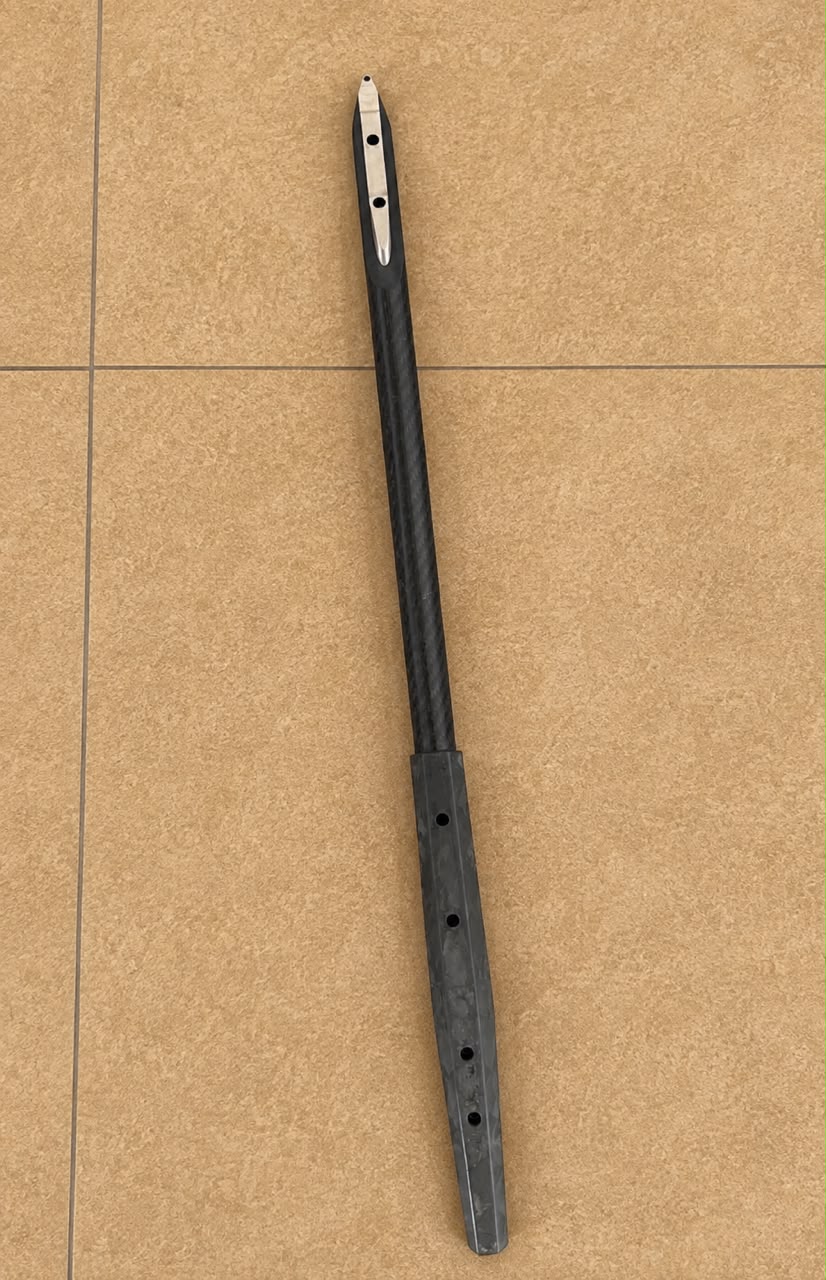


Used Armstrong 60cm fuselage


€300.00
The Used Armstrong 60cm Fuselage is a central structural component within an Armstrong hydrofoil system, connecting the front foil, mast, and stabilizer into one aligned assembly. Armstrong’s current 60cm option is available within its A+ System Titanium Core fuselage range, where a titanium rod core is wrapped in machined carbon fiber and paired with a hexagonal front-wing connection designed for a secure mechanical fit. The current TC60 also uses Armstrong’s stabilizer-shim interface and is designed so that Armstrong foils from different generations can remain compatible with the A+ System.
A 60cm fuselage sits between the shorter 50cm and longer 70cm options in Armstrong’s current titanium-core lineup. In practical terms, this middle length offers a balance between turning responsiveness, pitch stability, pump rhythm, and all-round versatility. Armstrong itself currently uses the TC60 in a flatwater paddle-start setup paired with a 98L board, APF 1880 front foil, 795 Performance mast, and Pump 202 stabilizer, illustrating its suitability for efficient pumping and paddle-powered foiling.
Because this is a used fuselage, actual condition matters as much as factory engineering. The front-wing interface, mast connection, stabilizer mounting area, threads, barrel nuts, fasteners, corrosion, impact marks, and alignment should all be inspected carefully before continued use.
Used Armstrong 60cm Fuselage – Technical Product Guide
Armstrong 60cm Fuselage Engineering, Foil Compatibility, Stability, and System Context
Armstrong Fuselage
The armstrong fuselage forms the structural spine of the hydrofoil assembly beneath the board.
It positions the front foil ahead of the mast and the stabilizer behind it, controlling the distance between those hydrodynamic surfaces.
That distance has a major influence on pitch behavior, turning response, pumping cadence, and overall feel.
Armstrong currently offers fuselages in multiple lengths and materials, including titanium-core and alloy designs.
60cm Length and Handling Balance
A 60cm fuselage provides a useful middle-ground geometry.
Shorter fuselages generally feel more responsive and compact in pitch, while longer ones can provide more leverage and stability.
The 60cm size therefore offers an all-round balance for riders who want responsive control without moving to the shortest possible setup.
Its suitability still depends on the rider, foil size, stabilizer, board, mast length, and discipline.
A+ System Compatibility
The current titanium-core design uses Armstrong’s A+ System.
The front-wing connection is hexagonal, which Armstrong says provides a naturally snug fit even before the hardware is tightened.
The rear stabilizer interface accepts form-fitting shims, allowing pitch characteristics to be tuned within the manufacturer-supported system.
Titanium-Core Construction
Current TC fuselages use a titanium rod core wrapped in machined carbon fiber.
This approach combines the structural strength and corrosion resistance of titanium with the low mass and shaping flexibility of carbon construction.
Armstrong positions the design as capable of handling different front-wing load cases while remaining compatible with a wide range of its foil generations.
HA Front Foil
An HA Front Foil generally refers to a high-aspect front wing designed around efficient glide and reduced drag.
A 60cm fuselage can provide a useful balance with these wings because the moderate length avoids an excessively long overall system while retaining predictable pitch control.
Exact pairing should still follow Armstrong’s compatibility recommendations.
HA Front Foil for Sale
The phrase HA Front Foil for sale represents shopping intent for a separate component.
A used 60cm fuselage should not be assumed to include a front wing unless the listing specifically states so.
The fuselage is only the structural connection point within the larger foil system.
Hydrofoil Front Wing
The hydrofoil front wing generates most of the lift once the system is flying.
The fuselage determines where that wing sits relative to the stabilizer and mast.
This geometry influences stability and maneuverability, but the front wing itself determines much of the system’s lift, glide, stall characteristics, and speed range.
Front Foil
A front foil should be selected according to rider weight, discipline, skill, water conditions, and desired performance.
The fuselage does not determine the ideal front-wing size by itself.
However, its length influences how that front wing interacts with the stabilizer and how quickly the rider feels pitch changes.
Hydrofoil Lift Stability
hydrofoil lift stability depends on the relationship between front-wing lift, stabilizer leverage, mast stiffness, fuselage length, speed, and rider input.
A 60cm fuselage provides a moderate lever arm between front wing and stabilizer, which can create a balanced feel between pitch stability and responsiveness.
The exact result depends heavily on the complete setup.
Armstrong Foils
armstrong foils manufactures complete hydrofoil systems, including front wings, masts, fuselages, stabilizers, boards, wings, and mounting hardware.
The company’s current fuselage range includes both titanium-core and alloy options, with multiple lengths available to suit different disciplines and riding styles.
Armstrong Foiling
armstrong foiling equipment is designed as an integrated system, but individual components can be configured differently depending on riding style.
A 60cm fuselage is especially useful when the rider wants one central geometry that can transition between pumping, surf, wing, and downwind-style setups without moving to an extreme length.
Armstrong Foil Board
An armstrong foil board provides the platform above the water, while the fuselage performs its structural work beneath the mast.
The board and fuselage are not directly connected to one another; the mast forms the vertical structural link between them.
Armstrong Foil Boards
Current armstrong foil boards span multiple categories, including downwind, surf, wing, wake, tow, and pumping-oriented designs.
The fuselage can often move between several board setups as long as mast and foil-system compatibility are maintained.
Surf Foil Board
A surf foil board is usually compact and responsive, making fuselage length an important part of the handling equation.
A 60cm design can offer a useful balance for surf-oriented riders who want responsive turning without reducing pitch stability excessively.
Surf Foilboard
The term surf foilboard refers to the board itself rather than the fuselage, but the two work together once airborne.
The board influences swing weight above the water, while the fuselage influences foil geometry beneath it.
Surf Foil Boards
Different surf foil boards may feel dramatically different with the same underwater setup.
Shorter boards reduce above-water swing weight, while the 60cm fuselage still maintains a moderate front-to-rear foil spacing.
Surf Foil
surf foil performance depends on the complete system.
Front-wing area, mast height, stabilizer choice, fuselage length, board dimensions, rider mass, and wave energy all interact.
The 60cm fuselage therefore should be treated as one tuning component rather than the single determining factor.
Foiling Board
A foiling board transfers rider input through the mast into the fuselage.
The fuselage then transmits that load between front wing and stabilizer.
Structural rigidity is therefore essential because flex or looseness can make pitch and steering feel less precise.
Foiling Boards
Different foiling boards may be paired with the same 60cm fuselage if the mast and A+ System components remain compatible.
This makes the fuselage a versatile part of a modular setup.
Armstrong Downwind Board
An armstrong downwind board uses a long, efficient hull to build water speed before takeoff.
Once flying, the fuselage becomes part of the submerged control system.
A 60cm length can work well where the rider wants efficient pumping and balanced pitch response after launch.
Armstrong Downwind Boards
Different armstrong downwind boards vary in volume and length, but the fuselage remains selected based on foil-system behavior rather than board liters alone.
Armstrong Downwind Foil
The term armstrong downwind foil generally refers to efficient foil combinations used for swell linking and long glides.
A 60cm fuselage can support this style by keeping the system responsive enough for pumping while retaining useful stability.
Armstrong Downwind Foil Board
An armstrong downwind foil board pairs efficiently with a fuselage when mast position, front-wing size, and stabilizer are balanced correctly.
The board creates speed before takeoff; the fuselage then helps determine how the foil responds once airborne.
Armstrong V1 Downwind Board
The armstrong v1 downwind board belongs to an earlier board generation.
Its use with a 60cm fuselage still depends primarily on mast and foil compatibility rather than board generation alone.
Armstrong Midlength
The armstrong midlength category sits between compact boards and long downwind designs.
A 60cm fuselage can complement this style well because both emphasize a balance between glide and maneuverability.
Armstrong Mid Length Board
An armstrong mid length board generally offers more glide than compact shapes without the extreme length of a dedicated downwind board.
Pairing it with a moderate-length fuselage can preserve that balanced handling philosophy.
Wing Foil Front Wing
A wing foil front wing determines low-speed lift, turning characteristics, and speed range.
The 60cm fuselage provides the structural relationship between that wing and the rear stabilizer.
Different front-wing sizes may make the same fuselage feel more or less responsive.
Armstrong Wing Foil
armstrong wing foil setups can use several fuselage lengths depending on the rider’s preference and foil choice.
A 60cm fuselage can be attractive for riders who want a versatile configuration that remains responsive without becoming excessively nervous in pitch.
Armstrong Wing
An armstrong wing provides the handheld propulsion source for wing foiling.
It is independent from the fuselage but influences how quickly the board reaches takeoff speed.
Armstrong Wings
Different armstrong wings suit different wind ranges and rider weights, while the underwater foil system—including the fuselage—determines the feel once flying.
Kite Armstrong
The phrase kite armstrong refers to Armstrong equipment used in kite-assisted foiling.
A 60cm fuselage can also be relevant in this discipline where responsive turning and compact underwater geometry are desirable.
Armstrong Performance Mast
The armstrong performance mast connects the board to the fuselage.
Mast stiffness is important because flex can influence how precisely rider input reaches the foil.
Armstrong currently uses its 795 Performance mast with a TC60 fuselage in one of its documented flatwater paddle-start setups.
Armstrong Integrated Foil Masts Price
The phrase armstrong integrated foil masts price refers to separate mast hardware rather than the fuselage itself.
Current mast prices vary by construction, length, and generation.
The fuselage should be evaluated independently unless a used listing includes the mast as part of a complete package.
Armstrong Integrated Foil Masts Price 2025
Likewise, armstrong integrated foil masts price 2025 is a historical price query.
Current 2026 pricing should not be inferred from older listings.
Foil for SUP
A foil for sup often prioritizes low-speed lift and efficient pumping.
Armstrong’s own flatwater paddle-start example uses the TC60 fuselage with an APF 1880 front foil and Pump 202 stabilizer, illustrating the 60cm platform in a SUP-style foil application.
Armstrong Foils for Sale
The phrase armstrong foils for sale covers front wings, fuselages, masts, stabilizers, complete kits, and other components.
A used fuselage should be listed clearly as a standalone component unless additional hardware is specifically included.
Used Condition Inspection
A used fuselage should be inspected carefully around the front-wing connection, mast interface, rear stabilizer mount, barrel nuts, fasteners, carbon wrapping, titanium core area, and threaded hardware.
Small cosmetic marks are normal.
However, cracking, corrosion, damaged threads, stripped hardware, deformation, deep impacts, or visible misalignment deserve more serious attention.
Hardware Condition
Armstrong’s current A+ System hardware uses specific M6 stainless and titanium components, including barrel nuts and stabilizer hardware.
Used hardware should be checked for rounded drive heads, corrosion, thread damage, or missing pieces.
Replacing compromised hardware is generally preferable to forcing damaged fasteners back into service.
Why 60cm Is a Versatile Length
A 60cm fuselage offers a practical middle ground between highly compact and more stability-oriented geometries.
It can support responsive surf and wing use while also remaining suitable for pumping and paddle-start applications.
Armstrong’s own use of the TC60 in a flatwater paddle-start configuration reinforces its versatility across efficient foil disciplines.
Overall Technical Perspective
The Used Armstrong 60cm Fuselage should be understood as a central structural and hydrodynamic component within an Armstrong foil system.
Current TC60 engineering uses a titanium rod core, machined carbon wrapping, A+ System hexagonal front-wing connection, and shim-compatible stabilizer interface.
Its 60cm length provides a useful balance between pitch stability, turning response, pumping rhythm, and overall versatility. Armstrong currently demonstrates the TC60 in flatwater paddle-start equipment, while its broader fuselage range confirms that 60cm remains an active modern system length.
For a used example, the most important factors are structural straightness, connection integrity, thread condition, hardware completeness, corrosion, impact damage, and compatibility with the intended mast, front wing, and stabilizer. When these areas remain sound, a 60cm fuselage can serve as a highly versatile foundation for surf, wing, downwind, SUP, and pumping-oriented foil configurations.
Performance, Handling, Stability, Responsiveness, and Real-World Riding Characteristics
A 60cm fuselage occupies an important middle position within a modular hydrofoil system. Its dimensions influence the relationship between the front lifting surface, mast, and rear stabilizer, so length affects far more than physical size. Pitch response, carving characteristics, pumping rhythm, stability, and the overall feeling transmitted to the rider can all change when fuselage geometry changes. For riders evaluating a pre-owned component, performance should therefore be considered alongside structural condition. A well-maintained component with secure interfaces and accurate alignment can preserve the intended handling characteristics, while damage or excessive wear may negatively influence how the complete setup feels on the water.
Balanced Length for Versatile Riding
The 60cm configuration offers a useful compromise between very short and considerably longer designs.
Shorter configurations can produce quicker reactions because the lifting surfaces operate across a more compact longitudinal distance. Longer configurations generally provide a greater stabilizing lever arm.
The intermediate length aims to retain responsive handling without making pitch behavior unnecessarily sensitive.
Consequently, it can suit riders who participate in more than one foiling discipline and prefer not to build an entirely different underwater configuration for every session.
Pitch Stability
Pitch describes the nose-up and nose-down rotational movement of the complete system.
The distance between the front lifting surface and rear stabilizer influences how rapidly these changes are felt.
A moderate-length configuration can provide enough leverage for controlled pitch behavior while remaining responsive to deliberate rider input.
However, the final result also depends on stabilizer dimensions, front lifting surface, mast stiffness, speed, rider weight, and equipment setup.
Therefore, length should never be evaluated in isolation.
Turning Response
Turning performance depends partly on how easily the submerged assembly changes direction.
A moderately compact configuration can feel responsive during carving because the lifting surfaces are not separated by an unnecessarily long structure.
This can create a connected sensation between rider input and foil movement.
Nevertheless, front-surface span, mast height, stabilizer geometry, board dimensions, and rider technique can have equally important effects on turning behavior.
Pumping Rhythm
Efficient pumping requires coordinated changes in rider movement and foil pitch.
The 60cm length can provide a useful balance because the system remains compact enough for responsive pitch changes while retaining enough stability for maintaining rhythm.
A rider who develops consistent timing may find this geometry suitable for linking energy between sections.
However, pumping efficiency also depends heavily on the lifting surfaces, overall equipment weight, rider technique, and environmental conditions.
Glide Characteristics
Glide cannot be attributed to the fuselage alone.
Most hydrodynamic efficiency comes from the lifting surfaces, mast profile, stabilizer, and overall system drag.
Nevertheless, the fuselage contributes by maintaining accurate alignment between these components.
A structurally straight, rigid component helps preserve the designed relationship between the lifting surfaces.
Therefore, maintaining structural integrity becomes especially important when evaluating used equipment.
Structural Rigidity
Rigidity influences how directly rider input reaches the underwater surfaces.
Unwanted flex can make control feel less precise because movement from the board may not transfer immediately through the mast and into the lifting surfaces.
A properly engineered central structure provides the mechanical connection required to maintain predictable geometry under load.
For a used example, unusual flex, cracking, deformation, or movement around connection points should receive careful attention.
Front Connection Integrity
The forward connection experiences significant forces during normal riding.
It should fit securely without abnormal movement.
Visible wear should be assessed carefully, particularly around mating surfaces and threaded hardware.
Small cosmetic scratches may have little practical significance.
However, deformation, cracking, badly damaged threads, or excessive looseness can compromise the connection and should be professionally assessed before further use.
Rear Connection Condition
The rear stabilizing surface depends on accurate mounting.
Even relatively small alignment changes can influence how the complete system feels.
Consequently, the rear mounting area should remain structurally sound, clean, and free from severe damage.
Hardware should engage correctly without requiring excessive force.
If components no longer seat as intended, the cause should be identified rather than compensated for through overtightening.
Mast Interface
The mast connection transfers rider input from the board into the submerged assembly.
This area therefore experiences substantial loading.
A secure interface contributes to predictable handling, while looseness can introduce unwanted movement.
On a pre-owned component, inspect the mating surfaces for deep impacts, deformation, cracking, unusual wear, and damaged threads.
The interface should remain clean so that components can seat together correctly.
Precision and Alignment
Accurate alignment is fundamental to hydrofoil performance.
The front lifting surface, fuselage, mast, and rear stabilizer must work together as a coherent geometry.
A bent or distorted component can change that relationship.
Therefore, obvious structural deformation should never be dismissed merely because the component can still be assembled.
A straight, properly maintained structure provides a much stronger foundation for predictable handling.
Surf-Oriented Riding
In moving swell, riders often value responsiveness because frequent directional and pitch adjustments may be required.
A moderate-length configuration can support this style by balancing maneuverability with useful stability.
Rather than producing the slower response sometimes associated with very long geometry, it can maintain a more compact feeling beneath the rider.
Actual suitability still depends on ability, wave conditions, and the remainder of the equipment.
Wing-Powered Sessions
During wing-powered riding, the rider may transition repeatedly between acceleration, carving, gliding, and pumping.
A versatile underwater configuration becomes valuable because the equipment must remain predictable across different speeds.
The 60cm length can provide a practical balance for this type of mixed riding.
However, beginners may prefer different stability characteristics from experienced riders, so equipment selection should always reflect skill level.
Paddle-Powered Takeoffs
Paddle-powered foiling places significant emphasis on efficient acceleration and controlled transition into flight.
Once airborne, a moderate fuselage length can support a manageable pumping rhythm without making the system excessively long.
The board and lifting surfaces remain critical to takeoff performance, while the central structural component becomes increasingly influential once the rider begins controlling pitch and maintaining flight.
Downwind Conditions
Open-water swell riding requires continuous adaptation.
The rider may accelerate on one section, glide through another, and pump to connect with the next source of energy.
Responsive pitch control can therefore become valuable.
A balanced 60cm geometry can support these transitions without focusing exclusively on either maximum stability or maximum responsiveness.
This versatility makes intermediate dimensions attractive for mixed-condition riding.
Rider Experience
Equipment behaves differently according to rider experience.
An advanced rider may appreciate faster feedback and use subtle movements to control pitch precisely.
A developing rider may prefer more stability and slower reactions.
Therefore, the same component can receive different evaluations from different riders.
Body weight, stance, board size, mast length, lifting-surface dimensions, and technique should all be considered before deciding whether the geometry feels appropriate.
Used Component Inspection
Pre-owned equipment should be assessed primarily through structural condition rather than cosmetic perfection.
Light scratches and normal finish wear can occur through regular assembly and transportation.
More significant concerns include cracking, deformation, corrosion, stripped threads, damaged connection surfaces, and obvious misalignment.
Previous repairs should also be examined carefully.
A professionally completed repair may remain functional, whereas poorly executed work can introduce uncertainty.
Saltwater Exposure
Marine environments can accelerate corrosion on exposed hardware if equipment is neglected.
Fresh-water rinsing after saltwater sessions can help remove deposits from accessible surfaces.
The component should then be dried before long-term storage.
Particular attention should be given to threaded areas and interfaces where moisture can remain trapped.
Routine cleaning can make later disassembly and inspection considerably easier.
Assembly Cleanliness
Sand and debris between mating surfaces can interfere with proper seating.
Consequently, connection areas should remain clean before assembly.
Forcing components together when contamination is present can damage surfaces or threads.
Regular cleaning also makes wear easier to identify because cracks, corrosion, and deformation are more visible when connection areas are not covered with salt deposits or dirt.
Transportation
Although relatively compact, the component should still be protected during transportation.
Repeated impacts against heavy equipment can damage connection surfaces.
Keeping hardware organized also prevents missing fasteners and reduces the possibility of incompatible components being used accidentally.
A padded equipment bag with separate compartments can provide useful protection during frequent travel.
Long-Term Durability
Durability depends heavily on correct care.
Avoiding severe impacts, rinsing after marine exposure, maintaining clean interfaces, using correct hardware, and preventing unnecessary overtightening can all support a long service life.
Periodic inspection provides an opportunity to identify developing wear before it becomes more serious.
For used equipment, understanding previous maintenance history can provide additional confidence.
Why Condition Matters More Than Appearance
Cosmetic scratches rarely tell the complete story.
A heavily photographed or frequently transported component may display visible finish wear while remaining structurally excellent.
Conversely, a clean-looking component could still have damaged threads or hidden connection problems.
Therefore, functional inspection should take priority over cosmetic expectations.
Straightness, structural integrity, secure interfaces, and hardware condition provide much more useful indicators of remaining serviceability.
Overall Performance Perspective
The 60cm configuration provides an effective middle-ground geometry for riders seeking a balance between stability, maneuverability, pitch response, pumping rhythm, and versatility. It can work across several riding styles because it avoids the extremes associated with exceptionally short or long configurations.
For a used example, however, its original performance characteristics can only be preserved when the structure remains straight and the connection points remain secure. Front and rear interfaces, mast attachment surfaces, threads, hardware, and overall structural condition should therefore receive careful inspection. When these areas remain sound, the component can continue providing precise mechanical alignment, responsive control, predictable pitch behavior, and versatile performance across a broad range of recreational foiling conditions.
Maintenance, Used Condition, Inspection, Cleaning, Storage, and Long-Term Durability
A pre-owned 60cm component can provide many additional seasons of dependable service when its structural condition, mounting interfaces, threads, hardware, and overall alignment have been preserved correctly. Unlike larger equipment where cosmetic wear is immediately noticeable, much of the important condition assessment here involves smaller mechanical details. Connection surfaces must remain properly shaped, threaded areas should engage smoothly, hardware must remain serviceable, and the main structure should show no evidence of significant deformation or cracking. Regular cleaning and inspection are particularly important after saltwater sessions because corrosion, sand, and mineral deposits can gradually interfere with otherwise precise mechanical connections.
Why Regular Inspection Matters
Inspection should become a normal part of ownership rather than something performed only after a problem develops.
Repeated loading, transportation, assembly, disassembly, saltwater exposure, and accidental impacts can gradually affect equipment condition.
Most minor cosmetic changes are not necessarily significant. However, developing cracks, damaged threads, unusual movement, or visible deformation deserve immediate attention.
Finding these issues early makes it easier to determine whether maintenance, replacement hardware, or professional assessment is necessary.
First Inspection of Used Equipment
When receiving a previously owned component, begin with a complete visual examination under good lighting.
Look along the entire structure and compare both sides.
Check for scratches, dents, impact marks, cracking, corrosion, previous repairs, and unusual surface changes.
Connection points deserve additional attention because they experience repeated mechanical loading.
If the component appears distorted when viewed along its length, professional inspection should be considered before regular use.
Checking Structural Straightness
Straightness is essential because the component establishes the longitudinal relationship between the lifting surfaces.
Even relatively small deformation can potentially alter alignment.
Place the equipment on an appropriate flat surface or visually examine it from several angles without applying force.
The objective is simply to identify obvious irregularities.
Attempting to bend questionable equipment back into shape should be avoided because additional damage may be introduced.
Inspecting the Forward Interface
The forward mounting area experiences repeated installation and removal.
Therefore, mating surfaces should remain clean and accurately shaped.
Normal finish wear can develop over time, particularly where components contact each other.
However, deep gouges, cracks, deformation, or excessive looseness require more careful evaluation.
A secure mechanical connection depends on correct surface contact, so damage in this area should never be concealed by simply tightening hardware more aggressively.
Rear Interface Inspection
The rear mounting region should receive the same attention.
Inspect the surrounding material, mounting surfaces, threaded areas, and hardware.
Everything should seat predictably without forcing.
If the rear component suddenly becomes difficult to install despite previously fitting correctly, contamination or mechanical damage may be present.
Identifying the underlying cause is preferable to forcing the pieces together and potentially creating additional wear.
Thread Condition
Threads are among the most important details on frequently assembled equipment.
Healthy threads should allow compatible hardware to engage smoothly.
Cross-threading, corrosion, accumulated salt, or damaged fasteners can make installation increasingly difficult.
Hardware should never be forced through abnormal resistance.
If a thread becomes questionable, cleaning and professional assessment are preferable to repeatedly attempting installation until permanent damage occurs.
Fastener Inspection
Fasteners should be examined for corrosion, damaged heads, worn drive surfaces, bent shafts, and deteriorated threads.
A badly rounded fastener can become difficult to remove later.
Similarly, corrosion may reduce reliability even when the component still appears usable.
Replacing worn hardware with the correct manufacturer-specified equivalent is generally more sensible than continuing to use compromised pieces simply because they still fit.
Avoiding Excessive Tightening
More tightening does not automatically produce a better connection.
Excessive force can damage threads, hardware, or surrounding structural material.
Connections should be secured according to manufacturer recommendations using appropriate tools.
If repeated loosening occurs, the underlying cause should be investigated.
Continually increasing tightening force can conceal a mechanical problem rather than solving it.
Cleaning After Saltwater Sessions
Saltwater leaves mineral deposits as it dries.
Over time, these deposits can accumulate around connection points and hardware.
Fresh-water rinsing after marine sessions helps remove contamination before it becomes difficult to clean.
Pay particular attention to joints, threaded areas, and recesses.
After rinsing, allow the equipment to dry thoroughly before enclosed storage.
Persistent moisture around metal hardware should be avoided.
Removing Sand and Debris
Sand can interfere with close-fitting connections and act as an abrasive between surfaces.
Before assembly, check each interface for contamination.
A few trapped grains may prevent components from seating correctly or can scratch surfaces when hardware is tightened.
Equipment bags should also be cleaned periodically because sand accumulated inside them can repeatedly contaminate otherwise clean components during transportation.
Appropriate Cleaning Methods
Routine cleaning generally requires a gentle approach.
Fresh water and soft cleaning materials are preferable for removing ordinary salt and dirt.
Harsh household chemicals should not automatically be applied because some substances may affect finishes, bonding materials, or adjacent components.
Abrasive tools should also be avoided on precision mating surfaces.
Cleaning should remove contamination without changing the geometry of the component.
Carbon Surface Inspection
Composite surfaces can develop cosmetic scratches through normal handling.
Superficial marks should be distinguished from deeper structural damage.
Cracks extending through multiple layers, significant impact damage, or areas that appear separated deserve professional evaluation.
Attempting to hide a questionable area with paint or cosmetic material does not restore structural integrity.
The condition beneath the finish is more important than appearance.
Metal Component Inspection
Metallic sections and hardware should be examined for corrosion and unusual discoloration.
Although high-quality materials provide substantial resistance to marine environments, no equipment should be assumed completely immune to neglect.
Salt deposits should not remain trapped around connections for extended periods.
Regular rinsing, drying, and inspection provide a straightforward way to preserve mechanical condition.
Avoiding Improvised Repairs
Precision equipment should not be repaired using unsuitable adhesives, random replacement bolts, fillers, or improvised modifications.
An incorrect fastener may have the wrong dimensions, thread profile, strength, or material.
Similarly, filling damaged connection surfaces can alter fit.
When structural or mechanical repair is necessary, manufacturer-approved components or qualified professional servicing provide a more dependable solution.
Storage Between Sessions
Clean and dry equipment before storage.
A protected indoor environment is generally preferable to prolonged exposure outdoors.
The component should not remain in standing water, damp sand, or a wet equipment bag.
Keeping individual parts separated with suitable padding can prevent them from repeatedly striking one another.
Hardware should also be organized so that correct pieces remain easy to identify.
Long-Term Storage
For extended storage periods, complete a detailed inspection beforehand.
Remove salt, sand, and visible contamination, then allow everything to dry thoroughly.
Store the component away from corrosive chemicals, excessive humidity, and unnecessary heat.
Heavy equipment should not be stacked directly against it.
Periodic inspection during long storage periods can identify environmental problems before significant deterioration occurs.
Transportation Protection
Transportation creates a different type of wear from riding.
Equipment may be subjected to vibration, repeated contact with other components, luggage pressure, and accidental drops.
A padded bag helps reduce these risks.
Separating hard metal components from delicate composite surfaces can also prevent unnecessary scratches.
Before traveling, ensure loose hardware cannot move freely inside the bag and damage surrounding equipment.
Inspecting After an Impact
Any significant impact deserves inspection even if obvious damage is absent.
Check the main structure, interfaces, threads, and hardware.
Look for newly developed cracks, deformation, or unusual movement.
If the component no longer assembles normally after an impact, forcing it into place should be avoided.
A change in fit may indicate that alignment has been affected.
Recognizing Normal Wear
Used equipment does not need to look new to remain serviceable.
Small scratches, finish wear around mounting areas, and minor cosmetic marks are expected after regular use.
These signs should be separated from structural concerns.
The most important questions involve straightness, connection security, thread integrity, and absence of significant cracking or corrosion.
Function matters considerably more than cosmetic perfection.
Maintaining Accurate Fit
Clean mating surfaces contribute directly to accurate assembly.
When dirt or corrosion accumulates, components may no longer sit exactly where intended.
This can introduce unwanted movement or alignment changes.
Therefore, maintenance supports performance as well as appearance.
Keeping connection surfaces clean and correctly fitted helps preserve the original mechanical relationship throughout the system.
Used Equipment Documentation
If available, previous ownership information can be useful.
Knowing approximately how frequently the equipment was used, whether repairs were completed, and how it was stored provides additional context.
However, documentation should complement rather than replace physical inspection.
Current structural condition remains the most important consideration regardless of how carefully the previous owner describes its history.
When Professional Inspection Is Appropriate
Professional assessment becomes sensible when significant cracking, deformation, severe corrosion, damaged mounting interfaces, persistent looseness, or questionable previous repairs are discovered.
Likewise, severely damaged threads should be addressed correctly rather than forced back into service.
Precision structural components benefit from proper diagnosis because apparently minor problems can influence the behavior of the entire assembly.
Preserving Long-Term Value
Well-maintained used equipment retains greater practical and resale value.
Regular rinsing, careful assembly, appropriate hardware, secure transportation, and dry storage can significantly reduce avoidable deterioration.
Keeping photographs or notes about repairs may also help document condition.
A structurally sound component with normal cosmetic wear is generally more valuable than visually cleaner equipment with questionable interfaces or damaged threads.
Overall Maintenance Perspective
Long-term durability depends on consistent, uncomplicated care. Inspect the structure regularly, keep mounting surfaces clean, rinse away salt, remove sand, protect threads, use the correct hardware, avoid excessive tightening, and store everything dry.
For a pre-owned 60cm component, structural straightness, secure interfaces, healthy threads, undamaged hardware, and absence of serious corrosion provide the strongest indicators of remaining service life. Cosmetic wear should be viewed realistically, while cracks, deformation, recurring looseness, and damaged mounting surfaces should receive immediate attention. With appropriate maintenance and responsible handling, a structurally sound example can continue delivering accurate alignment, predictable control, and dependable performance through many future sessions.
Be the first to review “Used Armstrong 60cm fuselage”
Related products
Used Product
Used Product
Used Product
Used Product
Used Product
Used Product

Used Product


Used Product
Reviews
There are no reviews yet.